

Top Hand Tripods
Top Hand CFX Carbon Fiber Tripod (24oz)
Top Hand CFX Carbon Fiber Tripod (24oz)
Couldn't load pickup availability
So light that it's counted in ounces, and the CFX only has 24 of those.
The Top Hand CFX tripod has finalized development and is currently in production. If you are interested in purchasing a CFX tripod before this fall please reach out to us with any questions using the contact page of this website. There will be a limited number made before September and production won't resume again until December.
Nowhere else will you find such a Backcountry tool as the Top Hand CFX Tripod!
Wheather deep into a wilderness backcountry of the West hunting for the most sought after bull elk or muley buck. To far back into the woods and swamplands of the Midwest after the whitetail buck of a lifetime. You will have the knowledge and confidence gained from this all-in-one hunting tool.
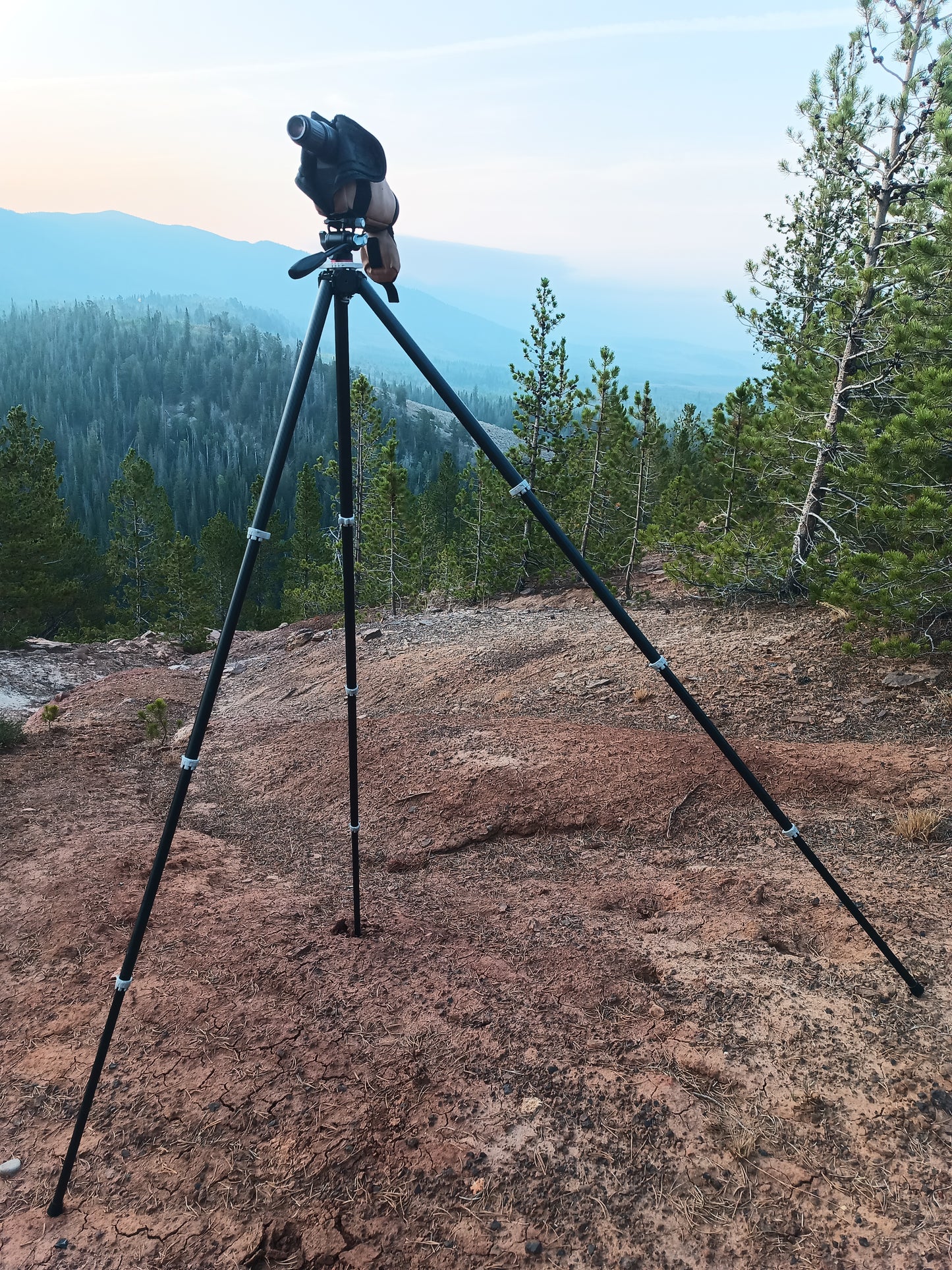
The CFX combines the versatility of the Original Top Hand Tripod with the weight savings and strength of carbon fiber technology. This ultralight hunting tool once again completes the logistics triangle of function weight and necessity when deciding what to take with you on your daily venture.
The dynamic of having a tripod with you will change the way you hunt for the better. You will glass better and longer to ultimately see more game. You'll also be more stable while hiking when using the legs as trekking poles, have a better quality shot when using the tripod as a gun rest, and with the Top Hand you will have that extra helpful hand when parting out your harvest.
The CFX Tripod operates the same as the Original Top Hand Tripod but instead of using aluminum alloy extruded tubing for the legs, we have developed a customized thin wall carbon fiber tube that has shaved a whole pound of weight off of the Original aluminum model!
This brings the CFX down to a mere 24 ounces with the same height as the Original Tripod at 67". Add your spotter setup on top of that and even taller people can easily glass from a standing position.
With the Cross~loc™ leg section tube lock system, you can be confident that the legs of the CFX tripod will hold up under demanding loads. From gassing to shooting to parting out the biggest game animals and pounding down the mountain using the CFX legs as trekking poles while packing that meat filled pack frame.
The Top Hand CFX is an indispensable hunting tool for your next hunt!
Product details:
-
Classic and proven unidirectional + twill weave thin wall customized carbon fiber leg tubing
-
Matte clear UV protective finish
-
Uber light at only 24 ounces
-
Same head design as the Original Top Hand for using the rope and Rally Clip compatibility
-
Crossloc™ 1/8 turn tube lock mechanism has the same function as the Original Top Hand but in a slightly different form.
-
Same weight hold strength as the Original, tested to hold up to 300 lbs.
What is carbon fiber?
In our experience with diving into the carbon fiber realm to build this tripod we have found that CF no doubt has superior characteristics to all other materials that can be considered when building a tripod. And this is why the vast majority of products built to be light and strong are made from CF material. These characteristics however do come at a cost, which is why CF is so expensive when a product is made using CF as its base component. The more CF used in the product, the more expensive it will be to the consumer.
There are basically 3 different ways of making a carbon fiber tube.
Roll Wrapped
In simple terms, the simplest way is called roll wrapped tubing. This is done by starting with a mandrel or smooth solid steel bar of a specific shape. From there, a sheet of woven carbon fiber cloth is impregnated with a resin and wrapped around the mandrel. Basically, this is done in multiple layers and directions depending on the end use of the part being made. After the desired layers are built up, a strip of heat activated shrink wrap tape is wound around the mandrel over the CF before the resin is cured, this wrap is kept in a very tight spiral and begins to squeeze out excess resin and air bubbles as the wrap is applied over the mandrel while compressing the layers of CF together. Once this is complete, the whole assembly is placed into a curing oven for a specific time and then is removed. After this, the steel mandrel will shrink slightly as it cools releasing itself from the cured CF tube and the tube is then slid off the mandrel.
Pultrusion
The second way is what is called pultruded carbon fiber. This is similar to how we make the aluminum tubes for the aluminum version of the Top Hand Tripod. However, an extrusion is basically pushing near molten aluminum through a die that is the shape of the part profile desired. Sort of like pushing playdough through a hole making it into a specific shaped bar. For a tube shape, the die has a solid core that creates the seamless tube when the material is pushed through. With pultrusion, the same principle is used but simply speaking, the material is pulled through the die instead of being pushed through it. Pultruded CF part shapes can be made much faster and in larger volumes than wrapping fabric onto individual mandrels. Pultrusion also has certain metrics that cannot be ignored when designing. For instance, pultruded CF is how most of your carbon archery arrows are made. An arrow only encounters certain forces, mostly axial, or the force upon the ends of the arrow when it is fired through a bow. Bending or flexural forces are next, like the arrow being fired through the bow or when it encounters the target. After this is twisting or torsion forces as the arrow spins through the air and the inertia when it hits its target, finally there is lateral forces, which with an arrow would be minimal and would be like hitting the arrow with a hammer from the side. All these forces take a specific toll on the CF tube and failure will occur the greater the force that is applied. With pultrusion, the biggest concern is twisting and lateral forces that cause its demise. Now these forces don't particularly have a huge impact when applying the tube to a tripod format but the issue with using a pultruded tube for a tripod application is its thickness needs to be fairly thick so the tube will not crush or flatten and kink when a bending or side force is applied. Also with regards to how the Top Hand is made, twisting forces are applied when locking and unlocking the tube sections Thus, when a pultruded tube is used for a tripod application, generally it is a thicker wall tube that results in a heavier tube compared to using a woven fabric wrapped or filament wound CF tube which have superior strength to weight compared to pultrusion. So in reality, a pultruded CF tube can essentially have the same weight as a thinner walled aluminum tube, only it will be slightly stiffer.
This is why we chose to stick with the classic woven fabric roll wrapped tubing for our tripods. Pultruded tubes can typically be made rather a dull finish like your arrows. But the bigger the tube the thicker the wall needs to be. This makes them a thicker walled heavier and cheaper made CF tube than if it were a woven fabric structured thin wall CF tube.
Filament Winding
The third is what's called filament wound tubing, and this is the most recent development in CF parts. This method is also the most expensive process. Filament winding is like the roll wrapped process, but each individual strand or filament of CF can be programmed into a custom weave and not limited by a certain degree weave angle or number of crossover strands in the weave like the woven cloth is made as in roll wraped tubes. This method is usually supported by CNC computer programming and is much more time-consuming and requires highly specialized machinery and engineering which adds cost to making the tube. However, this method can be very strong by tayloring the weave to the application of the tube. It can also create custom outside patterns like the large diamond or blotchy sort of camo looking pattern you may have seen used on some CF products in recent years. Though very cool looking, to obtain these looks and maintain optimal function, it can again require a thicker wall tube and thus ads weight and expense to the product.
When we set out to develop the lightest, tallest, and most versatile tripod in the hunting space, we were not going for looks nor your wallet. But still, the classic twill weave roll wrapped carbon fiber tube is undeniably recognized as being a very suitable top shelf material when it comes to the design triangle of function, weight and necessity.
If you are well versed on the CF realm we'd love to visit with you! Connect with us using the contact page. If you feel we have missed something, kindly let us know!
Otb.i™
"Life outside the box"
Share